By LEONG SIOK HUI
Post-retirement usually means living a tranquil life in a place you call
‘home’. But why do some people uproot themselves, move to a strange land
and start all over again? StarWeekend chats with a few Malaysia
My Second Home participants.
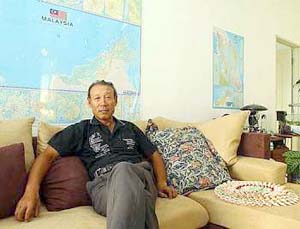
Hiroshi Ikawa, 60, lived in Hokkaido, Japan, all his life. After he
retired, Ikawa, whose wife died 22 years ago, decided it was time to
move on.
Ikawa left the Japanese Army 14 years ago and his last job was as a
golf course maintenance man. He gets a monthly pension of about 200,000
yen (RM6,400), but for now, he’s only entitled to 90,000 yen (RM2,900) a
month until he hits 63.
“In Chitose (where he lived), it’s tough to live on 90,000 yen a
month,” says Ikawa whose only daughter works as a nurse in the same
town.
 |
|
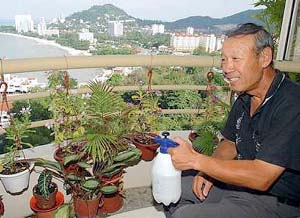
Ikawa loves that Malaysia is warm all year round and that homes in
Penang are affordable and big (below).
|
“Even the rental for a small apartment (less than 1,000sq feet/836sq
m) costs at least 80,000 yen (RM2,550). Besides, I can’t stand the cold
winters in Hokkaido, anymore.”
For Ikawa to live comfortably, he had to leave Japan. Last April, he
signed up with a Japanese agent for a one-month inspection tour to
several locations in South-East Asia. He spent a few days each in Penang,
Kuala Lumpur, Langkawi and the Philippines.
Six months later, he packed his belongings, sold his house, shipped
his car and moved to Penang for good.
Ikawa is one of the 8,000-plus foreigners so far who are now living
in Malaysia under the Malaysia My Second Home (MM2H) programme.
Successful applicants are given a 10-year social visit pass that can be
renewed indefinitely.
Dealing with “real” life
But getting a social pass is just the beginning for these
expatriates. Folks like Ikawa have to grapple with moving to a foreign
land, not knowing a single soul and adapting to a different culture and
language.
Ikawa’s grasp of the English language is limited to a five-year-old’s
vocabulary. Undaunted, he searched the web for information on MM2H and
signed up with Japanese-speaking agents to help him with the
applications, apartment-hunting and banking matters here.
Armed with an English phrase book, the plucky widower tries his best
to communicate with the locals. Every morning, he rides his motorbike to
nearby Pearl Hill to meet his newfound friends.
“For about an hour, I chat with other hikers – a
mixed group of Malays, Indians, Chinese and even Koreans. We talk about
everything under the sun, using sign and champon (a Kyushu-style
noodle dish with a hotchpotch of ingredients thrown in) language. And
somehow we understand each other,” says Ikawa during our interview at
his spacious, three-bedroom, sea-view apartment in Tanjung Bungah.
His rental is half of what he would have paid in
Japan and his current place is twice the size of a typical apartment in
Hokkaido.
Unlike expats who can afford lavish lifestyles,
retirees like Ikawa spend sparingly. He shops at the local market, cooks
at home and eats out occasionally.
“I love Malaysian food! My favourite is ais kacang,”
says the jovial man. His only splurge is a once-a-week golf game at the
club. Otherwise, he happily potters around the house, listens to music
or joins the activities at Coconut Lounge (which organises social
activities and events catering to Japanese expats in Penang).
Does he miss Japan?
“Zen zen koishiku nai (not homesick at all) . . .” he says. “I
want to live here until the end of my life.”
As good as it gets
In Japan, the changing season marks the harvest of a
certain produce, or dish, unique to that season. Fresh, crunchy
takenoko (bamboo shoot) signals the arrival of spring, or
teriyaki-glazed BBQ unagi (eel) supposedly cools the body in the
stifling summer months.
When each season arrives, Fukuko Konishi, 66, of Nagoya, looks
forward to flipping through her recipe books and whipping up a special
dish.
“I would think, ‘let’s make this? but, oh, I can’t get these
ingredients here’,” sighs Fukuko, who now lives in tropical Penang.
“It’s in moments like these that I miss Japan.”
Like Ikawa, Fukuko and her husband, Masayoshi, 69, moved to Penang
last year under the MM2H programme.
Fukuko first came to Penang and Langkawi for an inspection tour
before choosing to move to Penang. A retired garment-factory owner,
Masayoshi and his wife could live a cushy life in Japan on his pension.
“But we’d probably use up our money each month. Here, we can spend
half of it and save the other half,” admits Fukuko, a homemaker.
“Japan is such a consumer-based society with lots of things to buy.
Here, fewer choices mean we’re less spendthrift.”
It’s also Penang’s quality of life that led the Konishis here. They
live in a roomy, 2,500sq ft (2,090sq m) condominium perched on a hill
with a sweeping view of the sparkling-blue Andaman Sea.
“It’s impossible to get an apartment this size in Nagoya. It doesn’t
exist!” says Fukuko.
“Malaysia is a politically stable country and has a low cost of
living. And Penang has a low crime rate and good medical healthcare.”
Two of the private hospitals here have 24-hours, on-call
Japanese-speaking staff.
The Konishis only speak Japanese and a smattering of
English. They hired a licensed agent to handle their MM2H applications
and sought the help of a Penang-based, Japanese-speaking housing broker
to handle the housing matters. They get tips and advice from friends and
the staff at Coconut Lounge.
Fukuko keeps a pocket-sized Malay-Japanese dictionary in her handbag
when she goes out.
“At the market, I don’t even know the word for cabbage in Malay but I
just use sign language or point at the vegetables,” adds Fukuko. “But
Malaysians are very friendly and I pick up bits of Malay, Hokkien and
Mandarin.”
Initially, one of the things that got the Konishis perplexed is the
Malaysian concept of time.
“In Japan, when you set the time and date for an appointment, you
always show up on time,” explains Fukuko.
“Once we waited for hours for this repairman to come
and fix our apartment. We thought something had happened. Finally we
learned what’s called ‘Malaysian time’ and now we’re slowly getting used
to it.”
Since moving here, the Konishis have taken advantage
of cheap airfares for travels around South-East Asia. Mostly, they enjoy
their carefree life – the occasional game of table-tennis, shopping,
taking part in Coconut Lounge activities or having lunches with friends.
They also look forward to visits from their only son and his family who
live in Tokyo, and their friends.
“In Japan, this kind of life is just a dream,” says Fukuko.